
Think of a school where nobody knows the exit when a fire alarm rings. Or imagine the gate change message not reaching everyone in airports. With the right public announcement system, this problem is easily solved.
The system allows a single voice to reach every corner of a building or campus with clarity.
At its core, this technology carries live or recorded audio to speakers spread across a space.
Some setups are as simple as a microphone and a few speakers.
Many use IP-based, zoned networks that target one room or a complete city block.
The guide breaks down how the systems work, what makes them important, where they are used, and how to plan installation so it performs when it’s needed.
What Is a Public Announcement System and How Does It Work?
A PA system, in plain terms, is a setup that captures sound and pushes it out through speakers so a message reaches many people at once.
The two terms are often used interchangeably; both describe the same core function.
The process of working is simple:
- Microphone, music player, or pre-recorded files as audio sources
- Amplifier or processor to boost and shape the signal
- Transmission through a cable or network to the speakers
- Speakers converting that signal back into sound
Depending on the setup, announcements can play across an entire facility or only in selected zones like one floor, one department, or one classroom.

What Are the Main Components of a PA System?
Whether it’s a big PA system or a small one, they rely on certain core parts working with each other.
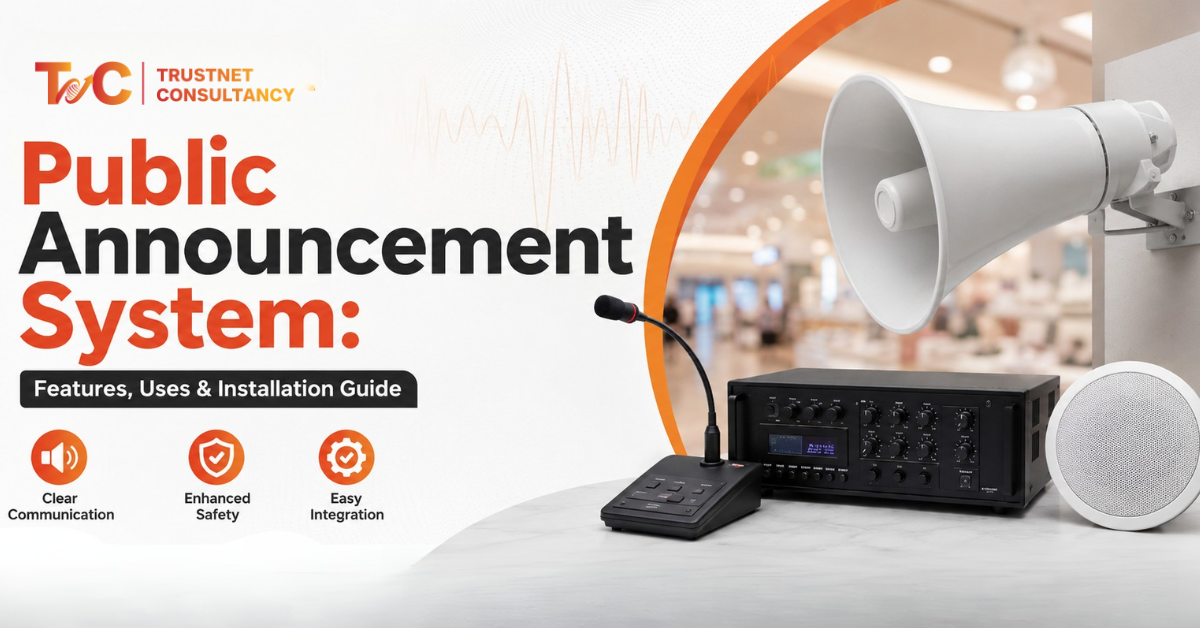
- Microphone and audio sources: These are used for background music, live announcements, or pre-recorded messages
- Audio processor or mixer: It balances and adjusts different audio inputs before they are sent
- Power amplifier: It boosts the signal so it can drive speakers with clarity
- Speakers: These include wall-mounted, ceiling, and horn-type speakers selected based on the space
- Cable and transmission infrastructure mainly carry out the signal from the source to the speaker
- Paging system: This allows an operator to pick zones and trigger announcements
- Network equipment: This is needed for IP-based systems, running over a local network.
Every part is important. A strong amplifier doesn’t matter if speakers cannot handle it, and a good microphone would not help if the wiring is wrong.
Types of PA Systems
Not every public announcement system needs to look the same. Here’s a quick breakdown of the common types:
| Type | Best For | Key Advantage |
| Wired PA system | Permanent installations | Reliable, low interference |
| Wireless PA system | Spaces where cabling is hard | Fast to set up |
| Portable PA system | Temporary events | Flexible, no fixed install |
| Fixed/centralized PA | Offices, schools | One control point for the whole site |
| IP-based PA system | Multi-building campuses | Remote control, easy scaling |
| 100V line PA system | Large facilities | Long cable runs without power loss |
Table: PA System Types
A small business might only need a portable unit. A hospital with multiple departments will likely need an IP-based or zoned fixed system instead.
Key Features of a Modern PA System
Older systems only handled basic announcements. Newer ones do far more:
- Multi-zone paging for specific zones
- Clear voice even within noisy spaces
- Remote tracking and system checks
- Priority during critical alerts
- Triggers for emergency announcements
- Background music in between announcements
- Scalability for adding new zones or buildings in the future
- Scheduled messages
- Network connectivity for centralized system control
What differentiates a basic setup from a modern system? This is where the real gap lies.
Network-based systems help facility managers handle it all from a dashboard, from monitoring faults to expanding without rewiring.
PA System: Where Is It Used?
These systems can’t be ignored. You see them wherever people gather:
Commercial and office buildings: internal system updates, guidance for visitors, and urgent evacuation announcements
Educational institutions: announcements for the entire school, emergency alerts, and class bells
Hospitals: emergency codes, staff pagers, and department announcements
Warehouses and factories: from safety rules to shift announcements, messages that deliver despite noises
Events and large spaces: schedule updates, crowd handling, and background audio for breaks
Public spaces: from airports and railway stations to bus terminals and malls, on-time announcements help people move safely.
PA System: How to Install?
Just putting the speakers on the wall or ceiling isn’t the right way to install. The planning is what makes it more efficient:
Evaluate the zone: Consider the size of the space, background sound, outdoor or indoor use, and number of zones required.
Plan placement of speakers: Pick between wall, ceiling, or horn speakers on the basis of coverage
Select the configuration of amplifier and speaker: Match the speaker capacity to the number and power requirements of the speakers.
Plan the zones: Decide what requires building announcements versus room- or department-specific ones.
Connect and configure tools and equipment: Set up the control system and check the signal flow.
Install wiring or network infrastructure: standard cabling for speakers for analog setups and network cabling for IP systems.
Check the sound coverage: Check consistency of volume, clarity of voice, feedback, and each zone before making them live.
Skipping any of these steps usually shows up later as dead spots, feedback, or announcements that can’t be heard.

How to Choose the Right PA System
A few practical factors decide the perfect choice:
- Types of announcements, such as emergency, scheduled, or general
- The size you need to cover
- Number of zones needed
- Wired, wireless, or IP-based setup
- Outdoor and indoor environment
- Need for future expansion
- Existing network infrastructure
- Background noise levels
| Requirement | Recommended Approach |
| Small/temporary space | Portable PA |
| School/office | Zoned fixed PA |
| Large industrial area | High-coverage/100V PA |
| Multi-building facility | IP-based PA |
| Outdoor/noisy area | Horn/column speakers |
Table: Approach to Selection of PA System
Traditional PA vs IP PA System: What’s the Difference?
Traditional PA systems send audio through analog cabling, with limited zoning and manual control. IP PA systems run over a network instead, offering:
- Easier zoning through software rather than physical wiring
- Remote management from any connected device
- Simpler scalability across buildings or campuses
- Better integration with alarms, access control, and building systems
Traditional setups still work well for smaller, single-building needs. IP systems make more sense for larger or multi-site operations that need centralized control.
Common Installation Mistakes
A few recurring mistakes affect performance:
- Choosing speakers without factoring in the environment
- Poor placement that leaves dead zones
- Ignoring ambient noise levels during planning
- Undersized amplifier capacity
- No proper zone planning
- Running audio and power cables too close together
- Ignoring feedback issues during setup
- Skipping zone-by-zone testing after installation
- Not planning for future expansion
Avoiding these early saves time, money, and a lot of frustration later.
The right public announcement system depends on your space, your zoning needs, your environment, and how you plan to communicate, not just the equipment you buy.
Careful speaker placement and proper testing matter just as much as choosing good hardware.
Get both right, and your announcements will be heard clearly, every time, in every zone.
If you’re planning to build real skills in system design, installation, and AV troubleshooting, TrustNet’s training programs are worth a look; they cover practical, hands-on learning aligned with what employers actually look for in this field.
FAQs
What is a public announcement system?
It’s a setup that delivers live or recorded audio like announcements, alerts, or instructions — to speakers across a defined area, so everyone in that space hears the same message at once.
How does a public announcement system work?
Audio from a microphone or source is processed and amplified, then sent to speakers through cables or a network, where it plays across the whole facility or selected zones.
What are the main components of a PA system?
A microphone or audio source, mixer/processor, amplifier, speakers, cabling or network infrastructure, and a paging console to control it all.
What are the different types of public announcement systems?
Common types include wired, wireless, portable, fixed/centralized, IP-based, and 100V line systems — each suited to different spaces and needs.