Audio Visual Solutions Every Growing Business Should Invest in for Better Collaboration
Most meetings don’t fail because of bad ideas. They fail because your audio visual solutions can’t keep up, whether that’s someone not hearing the person on the other screen or a slide that won’t cast.
India’s booming AV sector is driven by digitization and AI integration, making it prominent in the global market. With a projected value of 14,130 million USD, the AV solutions industry is bound to come up with increasingly modern solutions and products.
If businesses don’t invest in modern AV solutions, they are sure to fall behind in the market competition.
And it isn’t just offices catching up. Schools and training centres are rethinking their classrooms too, often through a digital smart classroom setup that mirrors what modern workplaces already use.
Why AV Technology Has Become Essential for Growing Businesses
The shift towards connected and collaborative workplaces
Traditional meeting rooms were built for one thing: people sitting in the same room, looking at the same whiteboard. That model doesn’t hold up anymore.
Teams are spread across cities, offices, and time zones, and communication has to work just as well for someone joining from home as it does for someone in the room.
This shift is why more Indian companies are investing in structured AV systems instead of piecing together random gadgets.
A proper AV setup handles presentations, hybrid meetings, and everyday information sharing without the usual friction.
Interestingly, the same push for better collaboration is showing up in education too, where interactive classroom technology now does for students what a modern meeting room does for employees: it makes information easier to see, hear and engage with.
Common collaboration problems
If you ask anyone who has been in a chaotic meeting, they will report the same challenges.
The problems usually repeat across businesses of different sizes, from large manufacturing plants to small startups. These challenges are also rooted in outdated tools or mismatched equipment.
- Screen sharing, which is easy to setup
- Presentations that look great on mobile but don’t work on big screens
- Poor audio cutting — between sentences or in and out
- Remote workers struggling to understand conversations
- Company updates that never quite reach everyone
- Meeting rooms that only work for people already inside them
None of these are people problems. They’re technology gaps.
Modern AV systems close them by handling audio, video and content sharing as one connected system instead of separate tools bolted together.
Once these gaps are fixed, teams stop wasting the first ten minutes of every meeting troubleshooting instead of talking, and that time adds up fast across a busy work week.
Audio Visual Solutions Every Growing Business Should Consider
Collaboration systems and video conferencing
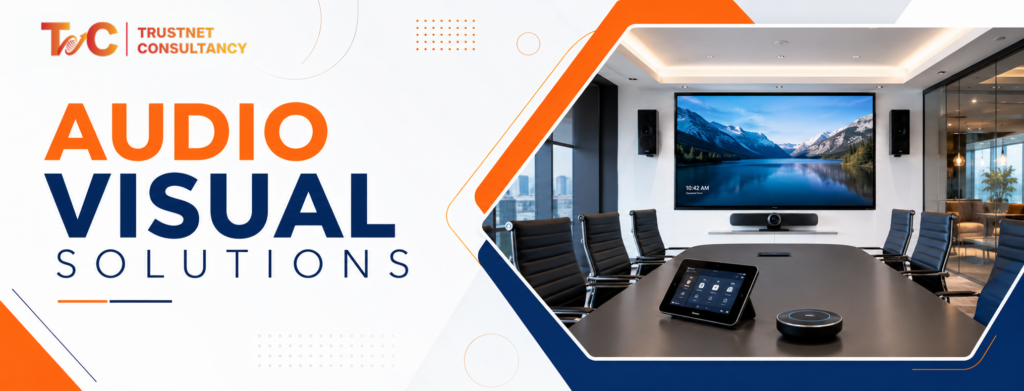
Hybrid meetings work only when everyone is audible and visible. The perfect video conferencing setup needs:
- Microphones pick up voices even in a large room.
- Systems designed for larger conference or meeting rooms, and not just small huddle zones
- High-quality cameras adjusting to the room
- Wireless collaboration tools for anyone to share their screen instantly
Get this right, and hybrid meetings stop feeling like a compromise.
Most businesses don’t need every feature available in the market. What matters more is picking a setup that fits the room size and the way your teams actually meet.
A small huddle room doesn’t need cameras and microphones that are required for a large boardroom hosting client calls.
Getting the match right early on saves both time and money. You don’t need to deal with frustration later, particularly once employees start depending on the system every day.
Interactive displays and wireless presentation solutions
Interactive touch displays have replaced the old whiteboard-and-projector combination in a lot of offices. They’re useful for:
- Brainstorming sessions where teams need to sketch and edit ideas live
- Client presentations that need to look polished, not improvised
- Employee training sessions with shared, interactive content
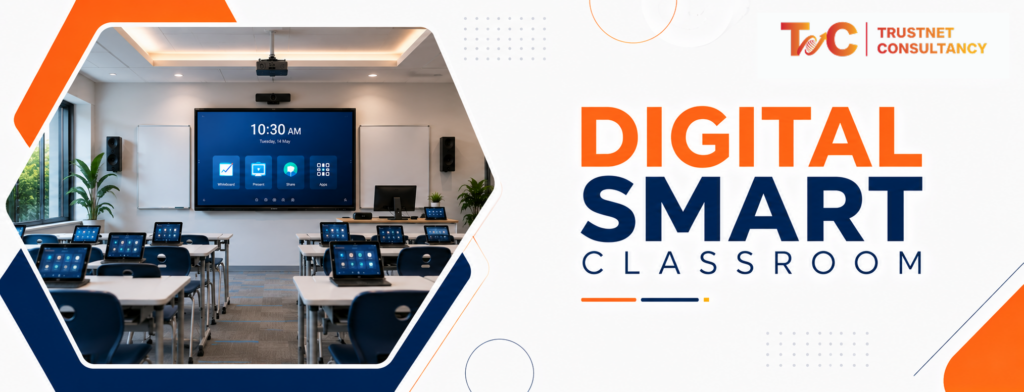
The same displays are now common in education. Many schools and colleges use this same interactive display technology, letting teachers run lessons that students can actually engage with, instead of passively watching a static slide.
Public address systems, digital signage and integrated AV
Meeting rooms are not the only places for business communication. It goes beyond that.
This is where digital signage, public address systems, and integrated audio systems play a key role. When combined, they support:
- Urgent announcements reaching every floor at once
- Centralised communication system for large buildings
- Daily office communication along with updates
- Visitor information displaying at lobbies and receptions
These systems are crucial in manufacturing plants, educational spaces, corporate offices, hospitals, and retail shops.
Each of them requires particular AV configurations, but the goal remains the same — information must be clearly received, no matter the premises.
Manufacturing units, for instance, often need public address systems more than fancy displays, since floor announcements matter more than visuals.
Corporate offices are more prone towards digital signage and video calls for client lobbies, updates, and event spaces. What’s most important? Matching the right audio visual solutions and tools combination to the environment. It’s more useful than adopting every technology all at once.
Choosing the Right AV Partner for Long-Term Business Growth
Features to prioritise before investing
Before signing off on any AV upgrade, check for:
- Scalability, so the system grows with your team
- Ease of use for non-technical staff
- Dependable video and audio quality
- Technology that won’t be outdated soon
- Matching with your current IT infrastructure
- Constant vendor support after installation
Skipping any would mean double payment — now and later.
It also helps to think a few years ahead rather than solving for today’s meeting rooms alone. A business that’s hybrid now will likely stay hybrid, and a training centre that’s digitising one classroom will probably want to expand that setup to more rooms soon.
Choosing systems that scale without a complete overhaul down the line tends to save both time and budget.
Why integrated AV solutions offer better value
Working with a single provider for consultation, system design, installation, integration and maintenance removes a lot of back-and-forth.
An integrated approach can handle your complete setup, rather than juggling between different vendors for displays, audio systems, and cameras. This is more important when something is damaged and you need quick support.
There’s also a cost angle worth considering. Buying hardware from one vendor, installation from another, and support from a third often creates gaps in accountability.
A video call is dropping – where the issue lies becomes unclear. If it’s a camera, network or software fault it is hard to determine. A single provider can eliminate the guesswork, as the same team designs, installs and maintains the system.
Supporting businesses and educational institutions with modern AV technology
TrustNet works with organisations that need this kind of end-to-end approach, offering audio-visual solutions, public address systems, interactive displays, video conferencing solutions, and wireless presentation systems.
On the education side, TrustNet also supports smart classroom solutions and digital smart classroom technologies, alongside installation and ongoing support once systems are live.
Whether it’s a corporate office running hybrid meetings or a college adopting interactive learning tools, the underlying need is the same: technology that helps people communicate without friction.
Choosing the right audio visual solutions and the right partner to support it directly improves collaboration, communication and productivity across both workplaces and learning environments.
If you want the right AV solutions for your business, check out the products and services of TrustNet and get the one that fits your needs.
FAQs
What should a growing business look for first in audio visual solutions?
Scalability and ease of use matter most early on, since a system that’s hard to operate rarely gets used to its full potential.
Are digital smart classroom setups only useful for schools?
No. Colleges, training centres and corporate learning programmes use the same interactive display technology for structured learning sessions.
Does upgrading AV systems require replacing existing IT infrastructure? Not usually. Most modern AV solutions are designed to integrate with existing networks and devices rather than replace them.
How does integrated AV support differ from buying individual AV products? An integrated approach covers consultation, installation and ongoing support from one provider, instead of managing multiple vendors separately.