
Companies often end up making announcements in noisy hallways, and most people miss them. This is the problem a public address system is designed to solve. The difference between an audible message and one that gets lost in chaos, whether it comes from students talking over one another, loud printers or machines making noise in the background.
If it’s a school or office paging call, each needs the right setup. It changes the clarity of information people get.
This guide explores how these systems work and how to choose the one that best fits your space, without decoding technical jargon you don’t need.
What Is a Public Address System and How Does It Work?
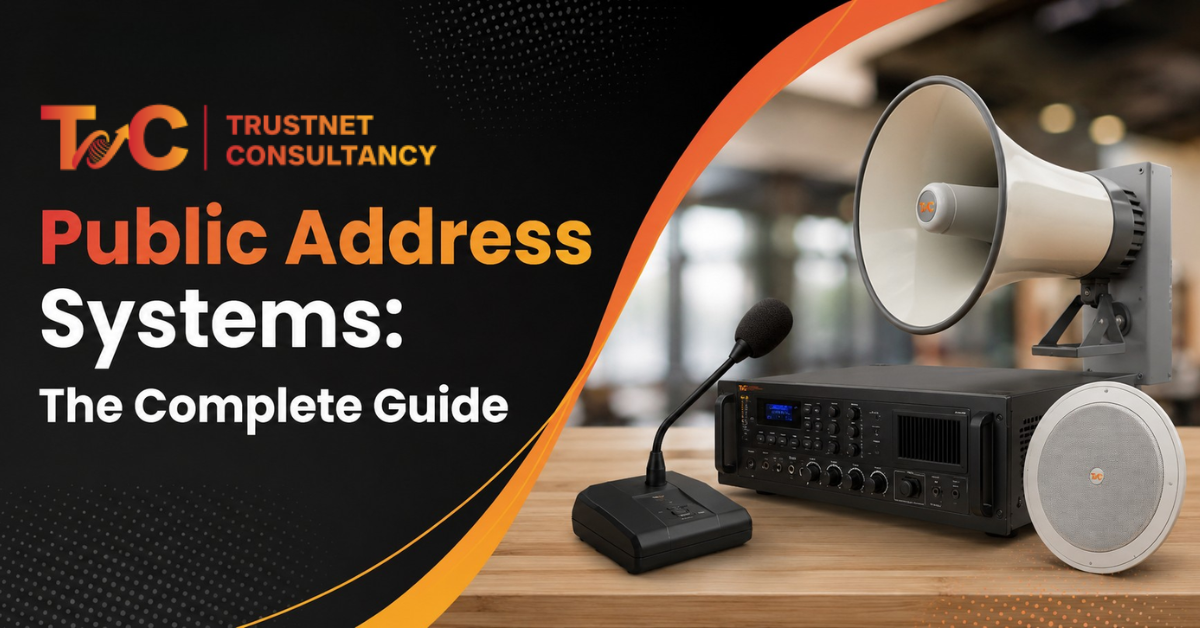
A public address system is an audio communication system that uses microphones, controllers, amplifiers, and speakers to deliver announcements and other messages clearly across a defined area.
What It Actually Means
At its core, it’s built for communication, not entertainment. Regular audio setups focus on sound quality for music.
A PA system focuses on speech reaching every corner of a space, even in noisy or spread-out environments.
That’s why schools, offices, and factories rely on it. A quick announcement needs to be heard clearly the first time, not repeated over and over.
The goal is always intelligibility, not volume for its own sake.
How Does a PA System Work?
The signal travels through a simple path:
- Microphone or input source picks up the message
- Mixer or controller manages the signal and routing
- Amplifier boosts the signal strength
- Audience hears a clear message
- Speakers turn noise into sound
Every part has a unique role, and the weaker links in the chain impact quality. A strong amplifier cannot fix poorly placed microphones. Neither can good speakers make up for noisy input signals.
Key Components of a PA System
- Microphones and paging stations
- Mixers or controllers
- Amplifiers
- Speakers
- Zone controllers
- Audio sources
- Cabling or network infrastructure
- Emergency notification components, where required
Not every building may need all of these. One small office needs only a few ceiling speakers and simple controllers. But for a factory, you need zoning, dedicated paging stations, and appropriate amplification to cover the required distance and noise levels.
What Are the Different Types of PA Systems?
- Conventional or analog systems
- Digital systems
- IP or network-based systems
- Wireless systems
- Voice evacuation and emergency systems
The “best” option isn’t about picking the loudest one. It depends on the building’s size, the number of zones, noise levels, and how much the system will need to scale in the future.
A small office and a sprawling factory rarely need the same setup, even if both want clear announcements.
How Should You Choose a PA System for Different Environments?
Every space has different communication needs, so the design should follow the environment rather than a fixed template.
Public Address System in Schools
School buildings need more volume to make announcements audible across classrooms and common grounds.
- Number of zones needed
- Emergency alerts
- Regular announcements and notifications
- Event communication
- Dedicated spaces for corridors, classrooms, and playgrounds
- Room for future expansion
School PA setups need to make every message audible. But they should not disturb any lessons. This perfect balance is more important than coverage.
PA Systems for Office Spaces
Targeted and zoned communication benefits office spaces.
- Paging for employees
- Event and meeting announcements
- Announcements for visitors and reception
- Urgent notifications
- Messaging process for each floor
It is not practical to broadcast every message to the entire building. With zoned paging, you can keep communication relevant while making it less disruptive. This applies mostly to open-plan offices, as noise travels easily in those spaces.
PA Systems for Manufacturing Plants and Factories
Manufacturing plants and factories deal with background noise. This is why announcements and messages often become inaudible in these spaces.
- Shift change alerts
- Floor and production announcements
- Emergency alerts
- Employee paging across large zones
These places need speakers and proper placement to ensure audibility amid ambient noise. Speakers meant for a quiet office don’t perform well in places with heavy machines.
Build Size and Noise Influencing PA Design
There are a few practical factors that help in creating the right setup:
- Surrounding noise levels
- Number of floors and buildings
- Complete area
- Ceiling height
- Outdoor versus indoor audio coverage
PA Systems: Why Zoning Is Important
Zoning helps you send the right message in the right zone.
- Indoor and outdoor distinction
- Floor-wise or departmental zones
- Announcements without disrupting nearby areas
- Instant broadcasts for emergencies across zones
You can save time during setup with the right zoning. Instead of rewiring the whole floor or building for a minor change, you can adjust the zone that demands it.
What Should You Check Before Installing a PA System?
Once you understand the basics, the next step is deciding what actually fits your building.
Check Speech Clarity, Not Just Loudness
Louder doesn’t always mean clearer. Background noise, speaker placement, and acoustic conditions all affect how well people understand an announcement, not just how loud it sounds.
Pick the Speakers Based On Environment
- Horn speakers for high-noise and outdoor spaces
- Ceiling speakers for school buildings and office spaces
- Wall speakers for corridors
- Column speakers for halls
- Outdoor speakers for open spaces and grounds
Every type is designed for a different zone. It’s important to match the speaker with the environment. This matters more than choosing the most expensive option. A misfit speaker is a waste of your budget and doesn’t improve the audio clarity.
Conventional vs IP-Based PA Systems
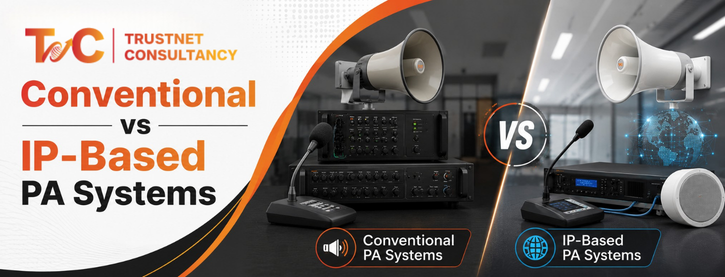
| Factor | Conventional PA | IP PA |
| Infrastructure | Dedicated audio cabling | Network infrastructure |
| Scalability | More limited | Easier to expand |
| Zoning | Possible | Highly flexible |
| Central management | Basic to advanced | Strong network-based control |
| Multi-location use | More complex |
An IP public address system usually makes more sense for larger campuses or multi-building setups that need centralised control.
Emergency Communication Needs
- Uninterrupted operations with backup power systems
- Prioritised announcements and clear instructions on evacuation
- Security and fire alarms
- Dependability during real emergencies and not only routine use
These aren’t optional extras for larger buildings. Even a mid-sized office benefits from a system that keeps working if the main power fails during a real emergency.
Plan for Maintenance and Future Expansion
- Everyday checks on speakers, microphones, and amplifiers
- Updating network components
- Infrastructure that is scalable, supporting added zones
- Regularly testing connections
PA System Installation: What You Need
- Check scalability
- Define the spaces needing coverage
- Identify the noise levels
- Find suitable speakers
- Decide on requirements for amplifiers
- Consider maintenance and support
- Creating separate zones within buildings
- Plan for urgent and high-priority communication
- Pick IP, wired or wireless architecture based on requirements
Choosing a public address system isn’t about buying the loudest speakers you can find. It’s about matching microphones, zoning, and speaker types to your building’s size, noise levels, and communication needs, whether that’s a school, an office, or a factory floor.
Need help designing a PA setup for your school, office, or industrial facility? Explore TrustNet Consultancy’s PA system solutions for professional system design and installation support.
FAQs
1. What is a public address system used for?
A public address system is used to deliver clear announcements, alerts, and messages across schools, offices, factories, campuses, and other large spaces. It combines microphones, amplifiers, controllers, and speakers to ensure people can hear important information without needing to be physically nearby.
2. Which type of public address system is best for a factory?
Factories generally need PA systems designed to operate in high-noise environments. Horn speakers, appropriate amplification, and zone-based paging can help ensure announcements remain audible across production areas. The right setup depends on factors such as background noise, facility size, speaker locations, and the number of zones.
3. What is the difference between a conventional and IP-based PA system?
A conventional PA system typically uses dedicated audio cabling, while an IP-based system uses an existing or dedicated network infrastructure to transmit audio. IP-based systems are generally more flexible for large campuses, multiple buildings, and setups requiring centralised control and easier expansion.
4. How do I choose the right public address system for my building?
Consider the building’s size, noise levels, number of zones, indoor or outdoor coverage, speaker type, emergency communication requirements, and future expansion plans. Schools, offices, and factories have different communication needs, so the system should be designed around the environment rather than based solely on speaker volume or equipment specifications.