
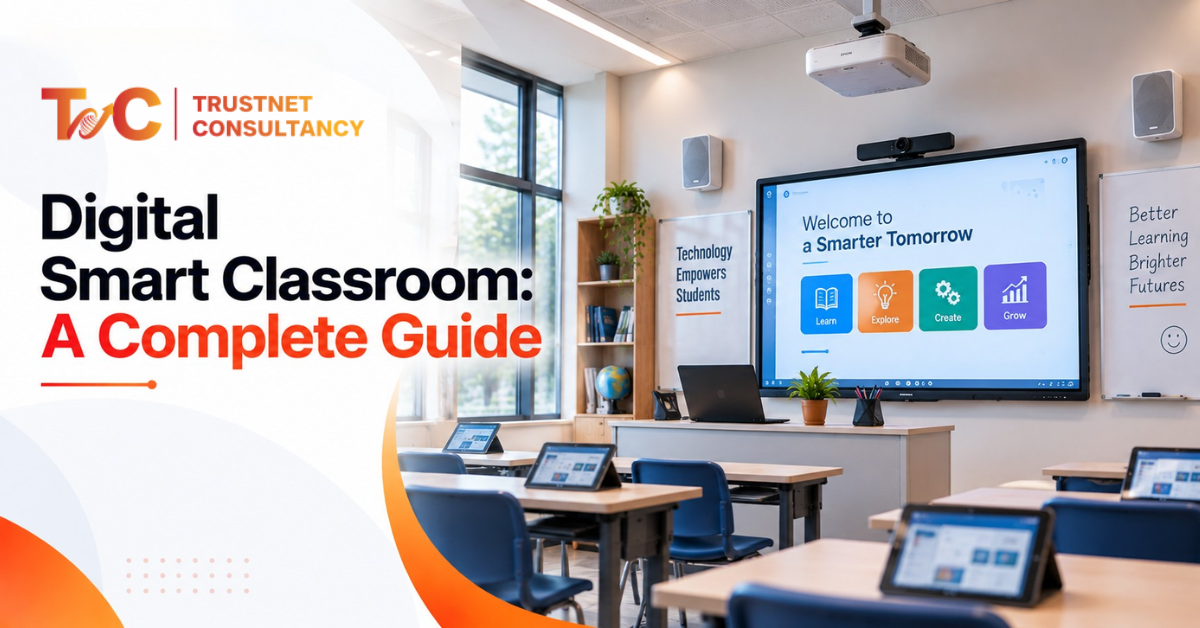
What do you think when you hear the word ‘classroom’? A blackboard, chalk, dusters? Well, that visual has changed with digital smart classrooms taking over. Now, when you walk into a classroom, you will find everything from AI tutors to smartboards.
The adoption of technology has grown steadily over the years. What started as an experiment in the late 2010s has transformed the modern education system. A study conducted in 2024 showed that 71 cities developed around 9433 smart classrooms in 2398 government schools.
But the planning is where schools often struggle. A large room with a small audio system, or a small room with a disproportionate smartboard, defeats the point of convenient learning.
Our guide explores what a digital classroom offers, and what schools need to consider before introducing a smart classroom.
Digital Smart Classroom: What It Is
A digital smart classroom is where traditional teaching methods blend with digital technologies.
It removes the dependence on just chalkboards with seamless integration of tech tools like computers, touch screens, smartboards, and fast internet.
Technology, when used optimally, becomes a great tool for improving students’ learning experiences. Teachers who want to adopt this approach can access a range of tools and services.
How It Transforms Learning
Technology moves the focus from passive learning to more interactive and active learning.
- Interactive lessons
- Improved collaboration
- Personalised learning
- Teacher Role
- Immediate feedback
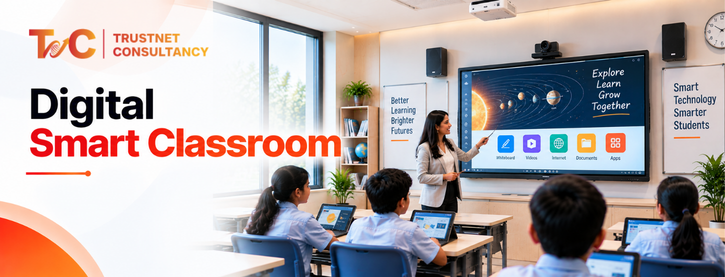
Traditional Classrooms Vs. Digital Smart Classroom
Traditional Classroom:
Tools: Whiteboards, notebooks, chalkboards, textbooks
Teaching: Teachers’ lectures with students sitting together and listening passively
Interactive: Only face-to-face communication in Q&A form
Smart Classroom:
Tools: Digital whiteboards, interactive flat panels and projectors
Teaching: Multimedia-integrated teaching with animations, videos, and graphics used to teach concepts
Interactive: Better visual engagement with touch screens and participation in the smartboards
The Key Components
As technology advances, the digital classroom components keep evolving. Here are some of the key components of a digital smart classroom.
- Smart TV and digital display
- Interactive smart board
- Projectors and presentation systems
- High-speed network and internet
- Quality audio and microphone systems
- Digital learning content and platforms
New features keep making these systems more interactive and make the learning process convenient and engaging.
How Digital Smart Classrooms Enhance Learning and Teaching
Digital tools are changing how teachers deliver the curriculum. The focus is more on application-based learning and analytical thinking. Different tools and platforms serve different purposes.
Here are some of the smart classroom components and their role in improving the learning and teaching process:
- Interactive Whiteboards: Touchscreens help students and teachers engage better by drawing, writing, and moving things on the screen. This ensures hands-on lessons and makes learning more interesting.
- Audio-visual Systems: From cameras and microphones to speakers, these ensure that everyone gets to hear the lessons clearly and take part in remote or hybrid sessions.
- Projectors: The new projectors are used for bright videos and presentations
- Fast Network: High-Speed Wi-Fi connects the devices to online quizzes, cloud tools, and virtual learning platforms.
- Learning Management Software: Platforms recognised by the industry are used to track attendance, store assignments, and post grades in one system.
- Content Apps: The right educational apps turn content into 3D models, animation, and virtual educational trips.
With this range of tools and platforms, you can boost engagement, personalise learning, and save time. Both learning and teaching become more interactive, leaving limited room for miscommunication.
AI and Modern Technology in Smart Classrooms
As AI is revolutionizing every field, it’s only fair that it will take over the edtech sector as well. AI mostly helps in generating individualized learning.
Modern technologies and AI turn classrooms into adaptive learning environments, improving teaching efficiency and student outcomes.
- Personalised Learning: You can get adaptive content that changes task difficulty considering the skill level and learning pace of the student. It offers custom paths as well, which helps to build strong study plans. Unbiased study is one of the key components, offering real-time feedback without waiting for the teacher.
- Immersive Classrooms: Digital tools like interactive whiteboards and touch screens increase student engagement and concentration. With AR and VR, you can create #D simulations of scientific models or historical incidents. Speech recognition offers language support for students so that they can practice a new language.
- Teacher Support: Automated grading with software scores on tests, quizzes, and regular assignments saves time for actual learning. AI tools often assist in designing the entire curriculum in just a few days. Dashboards monitor performance so educators can easily find learning gaps.
Technologies for Schools to Consider in 2026
The ever-evolving digital smart classroom technologies have changed classroom essentials.
Despite there being a number of modern AI tools, what schools need to prioritise are the core essentials for a digital smart classroom.
Here are some of the unmissable components every school should include in their smart classrooms.
- Smart audio-visual solutions designed for classrooms
- Interactive displays
- Strong networking for every classroom
- Content-sharing features and collaboration tools
- Video conferencing facilities
- Centralised device control system
Future-ready schools adapt to modern technology not only as a tool but as a way to promote creativity and problem-solving. With these essentials, schools can maintain their budget while shifting from a traditional teaching approach to an interactive one.
Challenges to Consider Before Adopting Smart Classrooms
Smart classrooms in India, however, have been limited by the disparity in regional adoption. Urbanized states like Maharashtra show 60.1% of schools adopting this approach, but the rural states lag in resources.
This is what’s mainly limiting the mass adoption across the country. Here are some similar common challenges that schools should consider before planning a digital smart classroom.
- Teacher training for digital tools and technology adoption
- The existing infrastructure limitations and exact technology requirements based on students, teachers, and resource availability
- Reliability of networks and the interconnectedness needed between classrooms
- Compatibility and integration of tools and equipment
- The essential technical support and maintenance requirements and services
- Privacy and security of data
- Scalability with growing requirements of schools
Smart Classroom Solutions’ Building Smarter Classrooms
Smart classroom solutions not only improve traditional learning spaces, but also make it more convenient for schools to get the exact platforms and tools needed in their context.
These ensure a blend of traditional learning and modern technology-based learning.
Professional AV solutions make implementation easier by combining separate software, hardware, and wiring in one system. This single point of contact is what makes it convenient.
Schools need to opt for integrated solutions rather than disconnected ones, as integrated systems save costs, make management easier, and enhance student learning.
A digital smart classroom combines traditional teaching with interactive displays, AV systems, smart boards, high-speed networks, and digital learning platforms.
The technologies make learning more engaging, personalised, and collaborative for both students and teachers. Schools planning for smart classrooms need to focus on must-have infrastructure, reliable connectivity, teacher training, compatible tools, data security, and scalability.
These can further improve modern education. However, rather than using disconnected tools, schools should go for integrated classroom solutions with hardware, software, networking, installation, and maintenance support for a future-ready learning environment.
Want to transform your classrooms with future-ready, integrated smart classroom solutions? Check out Trustnet Consultancy’s smart classroom solutions and select the ones to build a smarter and more connected learning environment.
FAQs
1. What is a digital smart classroom?
A digital smart classroom is a technology-enabled learning space that uses interactive displays, smart boards, audio-visual systems, digital content, and high-speed internet to make teaching and learning more engaging.
2. What equipment is needed for a digital smart classroom?
The essential components include interactive smart boards or displays, Smart TVs or projectors, quality audio systems, reliable internet connectivity, digital learning platforms, and classroom collaboration tools.
3. How do digital smart classrooms benefit students and teachers?
They improve student engagement through interactive lessons, support personalised learning, simplify lesson delivery for teachers, and make collaboration and assessments more efficient.
4. How can schools set up a digital smart classroom?
Schools should assess their classroom requirements, choose the right technology, ensure strong network connectivity, train teachers, and opt for integrated smart classroom solutions for easier implementation and maintenance.